Your head is full.
The rent is due Friday. The deck is due at 4. The dentist is still not booked, and you remembered it in the shower, again. Every item takes a turn at the front of your mind, so none of them gets done.
A brain dump puts all of it on one page, where you can see it.
What is a brain dump?
A brain dump is a list of everything in your head, written fast and in no order: tasks, worries, errands, ideas, half sentences. You do not sort while you write. You only empty.
It is not a journal, and it is not a plan. A journal is about how you feel. A plan is about what comes first. A brain dump comes before both. It gets everything out, so you have something to plan with.
Why a brain dump helps an ADHD brain
With ADHD, it is hard to keep a list in your head.
This is one of the best supported findings about ADHD. A 2013 review of 38 studies found adults with ADHD scored lower than other adults on working memory, the short-term store that holds a list while you use it (Alderson and colleagues, 2013).
So your list keeps itself alive the only way it can: by coming back. The dentist in the shower. The rent at 2 a.m. The email in the middle of a meeting.
Writing it down helps, and one study shows why the next step matters too. In five experiments, an unfinished goal kept pulling at people's attention and hurt their work on other tasks. The pull stopped when they made a specific plan for the goal, even before they did any of it (Masicampo and Baumeister, 2011). The relief came from the plan. That is why this guide does not stop at the dump.
How to do a brain dump in 10 minutes
Set aside 10 minutes and one place to write.
- Pick one place. One page or one app. Not a sticky note here and a notes app there, or the dump splits in two.
- Set a timer for 10 minutes. A clock makes it easier to start, and it gives the dump an end.
- Write everything, in any order. Big and small. The deck and the cat food. Half sentences and typos are fine.
- Do not sort yet. Sorting while you write stops the flow. You sort in the next step.
- When you slow down, ask three questions. What is due this week? Who is waiting on me? What at home keeps bugging me?
- Stop when you start repeating yourself. That is empty.
A real example
Here is a dump as it came out, typos and all.
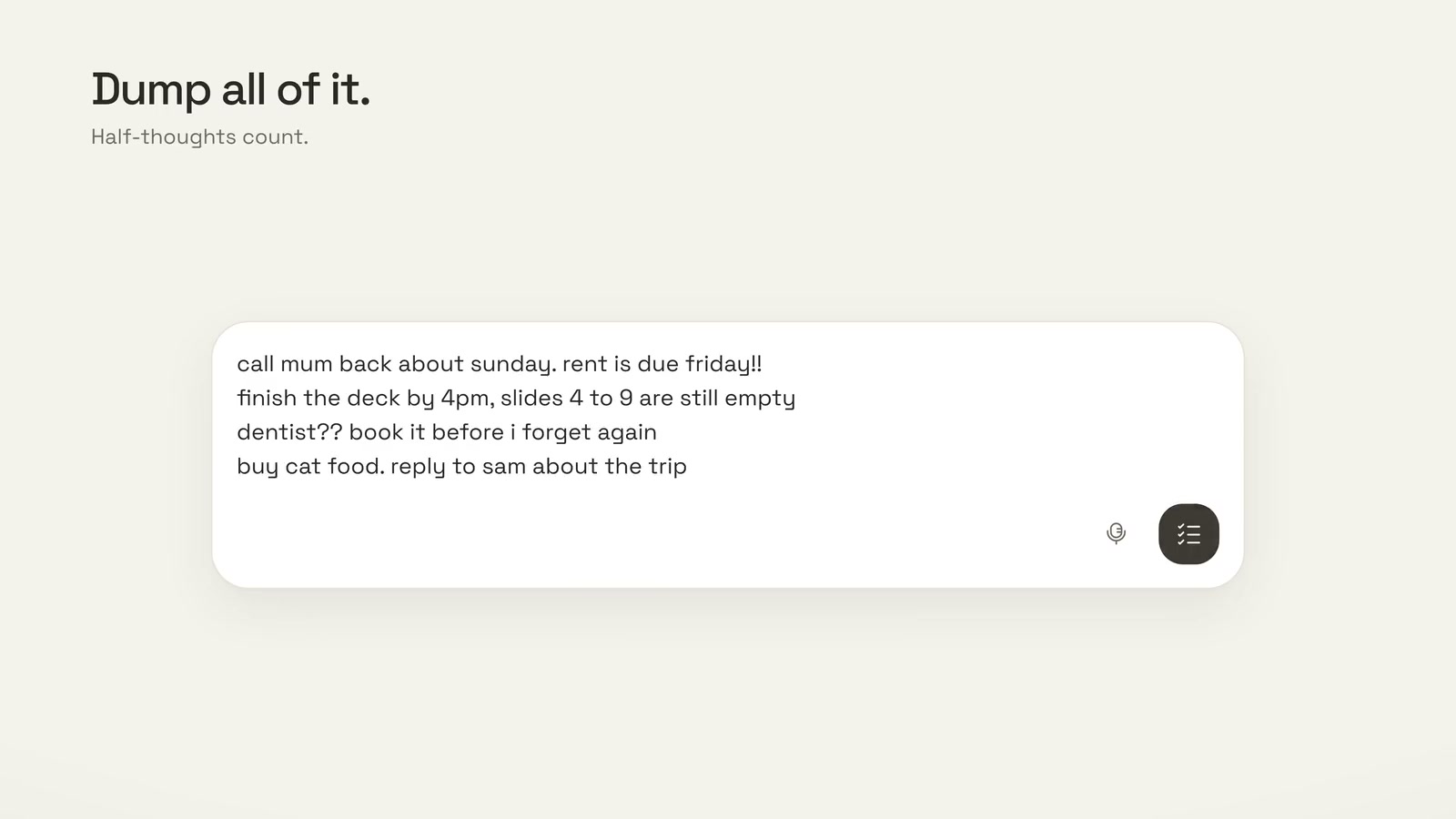
It is messy. That is the point. Nothing in it had to be decided before it was written down.
Here is the same dump as tasks:
- Call mum back about Sunday · Sunday
- Pay the rent · Friday
- Finish the deck · by 4 pm, with one step under it: slides 4 to 9
- Book the dentist · today
- Buy cat food
- Reply to Sam about the trip
Six small tasks. Each one starts with a verb. Four have a time, and now you can see which one runs out first.
What to do after the brain dump
Most guides stop at "write it all down".
Then you have a long list, and a long list is one more thing to hold. The dump only helps when it turns into a place to start. Four steps get you there:
- Move out what is not a task. Worries and ideas go into a separate note. They are written down now, so they can stop circling.
- Rewrite each task as a verb and a thing. "dentist??" becomes "Book the dentist". A verb tells you what to do first.
- Put a time on anything that has one. "by 4pm" is a deadline. Write it next to the task, where you can see it count down. An ADHD brain starts when time is almost up, so a visible time helps.
- Pick one and start it. Not the most important one. The one you can start in the next two minutes. Everything else can wait out of sight. If even that one will not start, read why ADHD task paralysis happens.
How often should you do a brain dump?
Do one whenever your head feels full.
For many people that is once a day, in the morning, before the day starts pulling. If your thoughts loop at night, try a short one before bed. In a sleep lab study, people who spent 5 minutes writing a to-do list for the next few days fell asleep about 9 minutes faster than people who wrote about what they had already done. The more specific the list, the faster they fell asleep (Scullin and colleagues, 2018). It was one study of 57 young adults, none chosen for ADHD, so treat it as a reason to try, not a promise.
A dump is not a system to keep up. Skip a day and nothing breaks.
Paper, a notes app, or an app that sorts it?
Any of them works for the dump itself. They differ in what happens after.
| Paper | A notes app | Kaapi | |
|---|---|---|---|
| Fast to write | Yes | Yes | Yes. One box. Type it or say it. |
| Turns into tasks | By hand | By hand | A model on your Mac does it |
| A time becomes a countdown | No | No | Yes, from the words you wrote |
| Where it lives | On your desk | Often synced to a cloud | Only on your Mac |
Paper is the fastest way to start, and it is always a fine choice. A notes app is always with you, but notes pile up and the sorting stays your job.
How Kaapi does it
We built Kaapi around this loop: empty your head, then start one thing.
You type the dump into one box, or say it out loud. A model that runs on your Mac turns it into tasks, and a time you wrote, like "by 4pm", becomes a countdown. Then Timi, a small pebble in the corner of your screen, keeps you company while you start.
Before we picked that model, we ran real dumps through 17 of them. The one we ship runs on the Mac itself, so your dump never leaves it.
Frequently asked questions
What is an ADHD brain dump?
An ADHD brain dump is a fast, unsorted list of everything on your mind: tasks, worries, errands and ideas. It helps because ADHD makes it hard to hold a list in your head. Once it is on the page, you can sort it into small tasks and pick one to start.
How long should a brain dump take?
About 10 minutes is enough on most days. Set a timer so the dump has an end. Stop earlier if you start repeating yourself, because that means your head is empty.
What is the difference between a brain dump and a to-do list?
A brain dump is everything, unsorted, including worries and ideas. A to-do list holds only tasks, each with a clear first action. The dump comes first. The to-do list is what you make from it.
Can a brain dump help me sleep?
It might. In one sleep lab study, writing a specific to-do list for 5 minutes before bed helped people fall asleep about 9 minutes faster than writing about finished tasks. The study was small and did not look at ADHD, so treat it as worth a try.
What if my brain dump is too long?
Long is normal. Move worries and ideas to a separate note, and cross out anything that is not yours to do. Then pick one task you can start in two minutes. The rest of the list can wait out of sight.
Should I do a brain dump on paper or in an app?
Both work. Paper is fastest and needs no setup. An app helps with the step after the dump: turning lines into tasks and showing times as countdowns. Pick the one you will open when your head is full.
Sources
- Alderson, R. M., Kasper, L. J., Hudec, K. L., and Patros, C. H. G. (2013). Attention-deficit/hyperactivity disorder (ADHD) and working memory in adults: A meta-analytic review. Neuropsychology, 27(3), 287–302. doi.org/10.1037/a0032371
- Masicampo, E. J., and Baumeister, R. F. (2011). Consider it done! Plan making can eliminate the cognitive effects of unfulfilled goals. Journal of Personality and Social Psychology, 101(4), 667–683. doi.org/10.1037/a0024192
- Scullin, M. K., Krueger, M. L., Ballard, H. K., Pruett, N., and Bliwise, D. L. (2018). The effects of bedtime writing on difficulty falling asleep: A polysomnographic study comparing to-do lists and completed activity lists. Journal of Experimental Psychology: General, 147(1), 139–146. doi.org/10.1037/xge0000374